MEDIAART 2G03: Stereo Recording
General Principles of Stereo Recording
The idea of stereo recording is that, instead of trying to simulate our interaural level difference and interaural time difference cue, we try to capture those cues directly by recording with two microphones instead of one. That is the basic idea of stereo recording.
When we do this, one thing we will start to understand is that different choices or configurations of microphones will produce different kinds of “stereo images” with consequences for realism, mono compatibility, and also the management of noise. Stereo recording is a very practical or economical technique because we just need two microphones to capture the complex spatial dynamics of a sound scene. I think it's this practicality or economic, economical nature of stereo recording that has made it such an important and popular technique over the last six or seven decades of sound recording.
Before we get into looking at some specific stereo techniques, let's just think about four general principles that might apply that can describe the relationship between these techniques, different combinations of microphones, and the two basic cues that our auditory system is sensitive to in terms of determining where sounds come from (ILD and ITD). Okay, we know there are other cues as well, but those are the really key ones that we're focusing on in these stereo modules.
#1: if we take two microphone capsules and we put them in the same location or almost exactly the same location, this will not ever produce interaural time differences. If something is in the same place, then energy from a given source will arrive at the same time. So if we put things in the same location, no interaural time differences.
#2: Conversely, if we take two microphone capsules and we put them in different locations, this will ALWAYS produce interaural time differences for off-center or off-axis sources. So microphones in the same location, we get interaural time differences. Microphones in different locations, we don't get inter-aural time differences.
#3: Interaural level differences (ILD) are going to be produced when microphones are in different locations.
#4: And interaural level differences can ALSO be produced even when microphones are in the same locations, by using cardioid or directional microphones that are pointed in different directions.
So if the above four principles make sense to us, thinking about the acoustic situation, we're ready now to talk about the common stereo techniques that people learn and apply in different situations (in the next four videos/transcripts).
AB and binaural stereo techniques
So the first set of techniques we'll talk about are the AB and binaural stereo techniques. The AB technique in general refers to any recording technique where you have two omnidirectional microphones and they're in different locations, as in the image below.
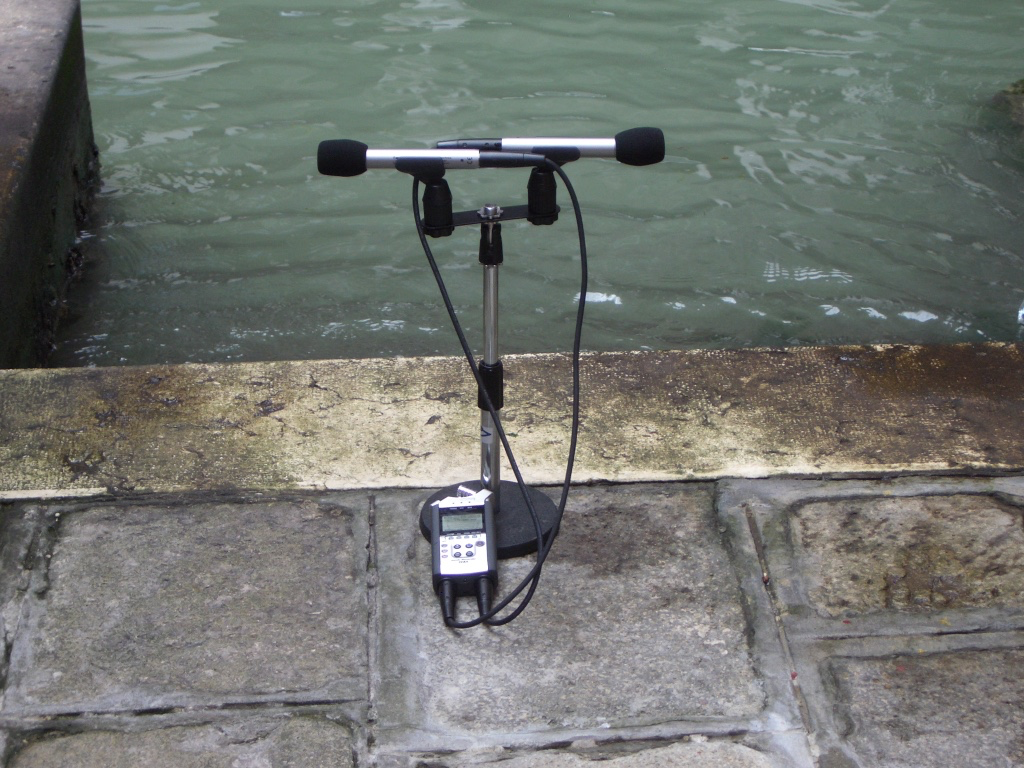
(Note: There's no way of knowing except me telling you that these two microphones are omnidirectional microphones.)
Now when you do this, usually you have a minimum of a heads width apart between the two microphones, but it could be further. For example, people might spread two microphones out over the entire width of a stage. Now when we do this, our left and right signals will contain interaural level difference (ILD) cues because of the different locations of the microphones. And it'll contain interaural time differences (ITD) as well for the same reason.
So this tends to give us something that is loosely thought of as more “realistic” stereo images. And perhaps this is because it's not so dissimilar from the setup of human hearing: we can see our ears as if they were two omnidirectional microphones on the side of our head. There is even a subset of the AB recording techniques known as binaural recording, where a dummy head is placed between the two microphones so that we get a realistic “head shadow” on the recorded signal. And this does produce especially realistic images.
When we use the AB technique or the binaural technique, it's not mono compatible because signals can arrive at different microphones at different times. Because there are those time differences. There's the possibility that the signals can cancel out if they're upside down with respect to each other when they're mixed down to mono. So if we care about mono compatibility, this technique is not going be that useful for us. And also because the microphones that we use in this technique are omnidirectional, we will have to use other techniques if we want to reduce noise. If there is a significant noise source in the scene, we're not going to be able to use microphone directionality to reduce noise if we're going with this technique.
XY stereo
The XY stereo technique is when we have two cardioid microphones at the exact same location, or more or less the exact same location, but pointed in different directions, e.g. 90 degrees apart or 110 degrees apart. The H4N recorders we've gotten used to using in this course have a pair of built-in microphones arranged into the XY technique.
Now when we do this, we're going to have an inter aural level difference (ILD) because of the directionality of the microphones. They're pointed in different ways. We're NOT going to have an inter-aural time difference (ITD) though, because the microphones are in the same place. So the energy from an off-axis sound source is going to arrive at both of these microphones at the exact same time, but with a different level or amplitude. This has the consequence that is generally less “realistic” than AB. But it is mono compatible because there's no time differences in the signal (that could lead to “misaligned” things canceling out when mixed together).
Because the two microphones are cardioid, we’re going to have weaker capture of things that are “behind” the microphones, which can be used to help control noise.
Because the microphones in the XY technique are in the same place, this technique doesn't take up very much space. And in fact, it's often the built-in default with portable recorders.
A final nuance of this technique is that we may sometimes find that sounds in the centre are not picked up as clearly as sounds that are off to the left or the right. And that's because neither of these microphones are pointed at the center in this technique. So sounds that are in the centre are going to be off-axis to each individual microphone. And we might remember from our discussion of cardioid microphones that as sounds move off the zero-degree line, as they become more and more off-axis, generally speaking, the capture they provide gets less detailed/accurate. The sounds are attenuated more OR they're attenuated more in ways that sometimes are not the same for all frequencies. So these effects combine to give us the potential for a “hole in the middle” when we use the XY stereo technique.
Near-coincident stereo
Near coincident techniques are when we have two cardioid microphones, but they're in different locations AND they are pointed in different directions. So we capture interaural level difference (ILD), both because of the location and the orientation of the microphone. And we capture interaural time difference (ITD) because microphones are in different locations.
The fact that we have both of those cues in there makes this technique more realistic than XY, at the cost of it no longer being mono compatible (because we have time differences again, just like we had with AB). Unlike AB, we're using cardioid microphones. So we are able to reduce noise by pointing away from something.
There is going to be a hole in the middle problem to some or other extent. None of these microphones are pointed at the centre and so sounds in the centre are going to be off-axis to all the microphones, and this becomes more severe the further the microphones are away from each other. The hole in the middle program is less severe for the XY technique, and more severe for the near coincident techniques. At the extreme case, if we have the microphones super far apart, a sound source in the middle, close to the centre could be 90 degrees off-axis to both microphones!
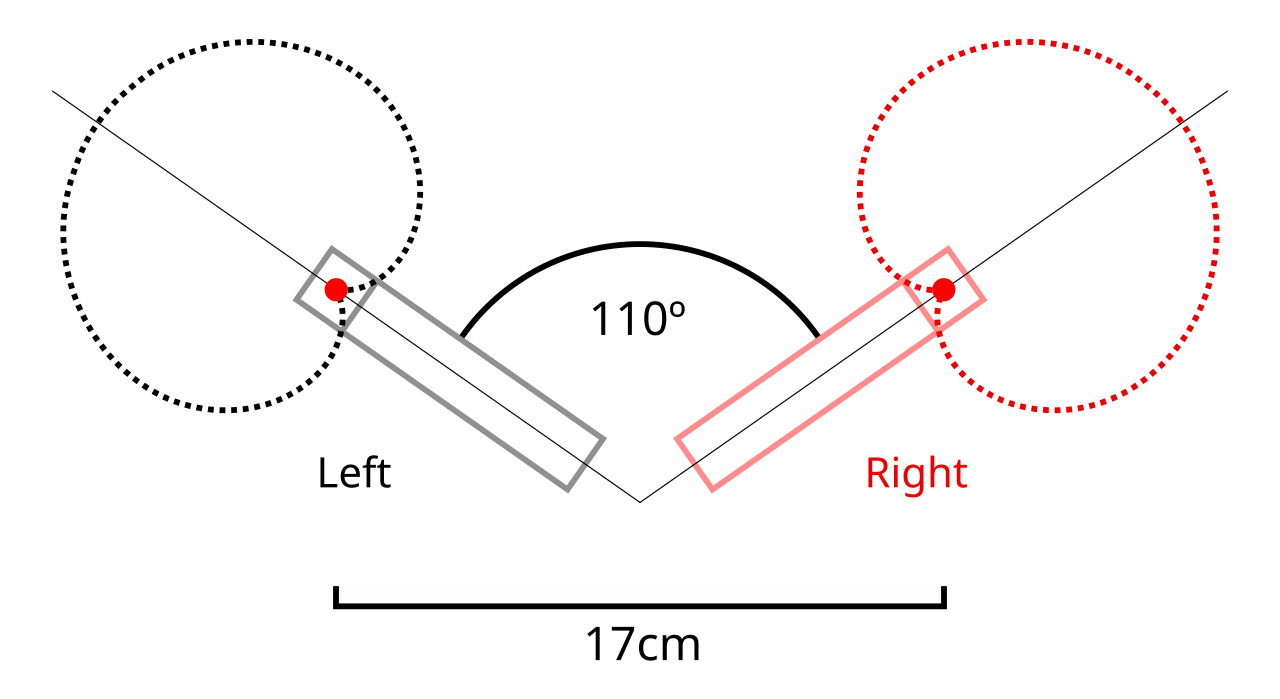
This family of techniques was very popular with the radio broadcast of concerts. And so particular examples of the technique are sometimes named after radio stations. This image [below] is a diagram of what's called the ORTF technique, which is an example of a near coincident technique that was made a standard by French public radio, which was called the ORTF. So even nowadays, even if we have nothing to do with French public radio, we might hear people talk about ORTF in connection with this particular example of a near coincident technique. In the ORTF technique, the capsules are 17 cm apart, and the angle of the two microphones is 110 degrees.
MS stereo
In the “MS” or “Mid-Side” technique, we start by taking a cardioid microphone and we point it straight at the centre. And we call the signal that we get from that microphone M or mid. And now we add a second microphone, which is a figure eight microphone, in exactly the same place, but pointed left and right. And we call this S for side. If you remember, a figure-eight microphone is a microphone that's equally sensitive in two directions, and in this technique we think of those directions as both left and right or “side”.
Now if we take those two signals just as they are, we have what would be called an MS or mid-side “encoded” signal. If we want to listen to that on a left and right set of loudspeakers or the left and right channels of our headphones, we can decode it as follows: We can take the mid channel (M), and we add the side (S) to give us a left signal. And at the same time, we take the mid signal (M) and we subtract the side (S) to give us a right signal. When we say “subtract” here, we can think about this as if it was like mixing in that signal, but with the signal turned upside down.
L = M + S
R = M - S
If we take these decoding “equations”, but we increase the level of the side signal (S), that would make the left and right “more different” than each other. The bigger S is, the more different L and R are going to be. And conversely, if we decrease the level of the side signal, the left and right are going to become more the same. They're going to become like a mono signal: if we completely reduced the side signal to nothing, all that would remain would be M in both the L and R signals and we would just be listening in mono. This is important because what it shows us is that this recording technique and this way of encoding and decoding a signal gives us some ability to change “how stereo” the result is.
This has sometimes been felt to be important for film and television sound. They might do a recording on set somewhere, and then later when they listened to it, they might feel like that the sound is too wide or too stereo for what is presented on the image or vice versa. So this technique has been used a lot in film and television. It's definitely not a very realistic technique, but, film and television is not usually very realistic, either, so...
It is mono compatible because there are no time differences. There are two microphones that are in exactly the same place. And because they're directional microphones, a cardioid microphone, and a figure-eight microphone, we do have some ability to reduce noise by pointing away from it.
A final point about this mid-side (MS) technique is that it is possible to take existing stereo signals, left and right signals, and encode them into mid-side, do some things to them, and then decode them back to left, right. And in fact, this is the basis of many plugins that you'll find out there that manipulate stereo imagery in different ways. For example, in Reaper will see that there are plugins for doing MS encoding and decoding.
Choosing Stereo recording techniques
We've talked about four main families of stereo technique. So how do we go about choosing between them?
Well, if we care about realism, we're likely to want to choose techniques that capture interaural time differences (ITD), by having microphones in different places. And so really our choices here are AB, binaural (which is a kind of AB), or near coincident. Those are the techniques where the microphones are in different places.
Conversely, If mono compatibility is important, then we're going to have to use techniques that have microphones in the same places, such as XY or MS, where XY is potentially a more realistic technique and MS is potentially a less realistic but also very flexible technique.
If we have noise that we want to reduce in the scene using directional microphones, will need to use techniques that use directional microphones (eg. cardioid), such as XY, or near coincident, or mid-side. And in this set of techniques, near coincident represents the most “realistic” technique because it has time differences in it.
If we really strongly want to avoid the hole in the middle, we need to use either AB, which uses omnidirectional microphones (so no sounds are off-axis of any microphone), or mid-side because there's a mic pointed at the center.
And if we want to make a mid-side (MS) signal to be able to manipulate the “stereo-ness” of the result, then we'll need to use the mid-side technique. However, I think we should note here that it is possible to manipulate the “stereo-ness" of other signals using various techniques and plugins. And so perhaps mid-side recording will become less common as time goes by, and as these other techniques become more common and well-known.