MEDIAART 2G03: Modes of listening
Referential and symbolic listening
Referential listening is a type of listening where primarily what we're doing is identifying the source of the sound. For example, if I hear something and I say it's a dog, I'm not really saying anything about what the sound "sounds like", but I'm definitely saying something about where the sound came from, about where it originated.
In each of the following statements, "a dog," "Dr. 0," a "piano," "an annoying person," "the sounds of the city," they're all statements about where the sound is coming from. And probably if someone asks you, "What are you hearing?" or "What are you listening?" you've answered in this way, in many situations.
And as we've already noted, this isn't a statement about what any of those things sound like. In fact, if we look at these words, "a dog," "Dr. 0," "piano," "anannoying person," these are not in and of themselves, inherently statements about sound at all. A dog can also make no sound, so can I. A piano can not be played, an annoying person can not particularly make sound, and so on and so forth. So when we engage in referential listening, we make a reference back to what made the sound, but there's no information about sound as such in that reference.
Another type of listening that we employ a lot in everyday life, is symbolic listening. And symbolic listening is listening that treats sound as codes, that can be translated into some other meaning. And the most salient example of this would be spoken language. We listen to the stream of sounds that come from someone's voice, and in that stream of sounds, we identify some of those as phonemes, and then phonemes go together to make words, and words go together to make sentences, and sentences go together to make paragraphs, and those sentences and paragraphs themselves might be understood on multiple levels and in multiple ways.
So in this process of taking the sound and decoding it to get some meaning out of it, some symbolic meaning out of it, we're often moving away from the sound as we do that. The sound is necessary for the meaning to be communicated to us, but once we've turned it into words, sentences, paragraphs, and propositions, the sound doesn't play a key role anymore; it is to some extent, discarded.
Reduced Listening
So another type of listening (and it's one that we're going to explore I think in some interesting ways in this course), is called reduced listening. And in reduced listening, what we do is we identify a sonic phenomenon using vocabulary that is sound specific - in other words: using vocabulary that is inherently tied to sound and sounds, and ideas about sound.
For example, when we say that something is quiet, that is a statement that cannot really or fundamentally be about anything other than a sound. Okay, it's true that we also use the word "quiet" metaphorically. We might say "a quiet person" to maybe talk about their personality, but that metaphorical use is referring to a more fundamental or basic use of the word that has to do with sound. Is the sound quiet or is it, conversely, loud?
Another common example of reduced vocabulary would be to talk about higher pitch and lower pitch. We might say that one sound is higher in pitch than another which is lower in pitch.
There are also very specific sounds, very specific words, for things that can only be sounds. And that's also vocabulary that we can use in reduced listening. When we say that something is "a hiss" or "a pop" or "a boom," these are not things that make sounds, these are themselves sounds.
This type of listening is important for a number of reasons (we will come back to this in a later module), but I just want to briefly say now that reduced listening is something that we have to do when we don't know or when we can't really say what it is that we're hearing. In other words, when the source of a sound is ambiguous in some sense, we are put in the situation of being compelled to do reduced listening. And as we're going to see, that makes it quite important for people who are working with audio creatively.
Some Reduced Listening Vocabulary
In Pierre Schaeffer's account, reduced listening is sort of like the opposite of referential listening. And when Schaeffer was first thinking about these things, and experimenting with these sounds, he had an experience (that he would later recount in various ways) with a sound that was accidentally repeated because of a closed groove on a disk. There was an accidental situation (this is still quite common with records), where the record got into a loop because of a defect. And the same sound, in some sense exactly the same sound, was repeated again and again and again and again and again. And as this happened, he noticed that his hearing changed.
And in another situation - we will do this experiment as well - where I will repeat a sound for you (you can do it yourself now if you'd like). And as you listen to that sound repeatedly, what will happen is that your brain will grow bored with identifying the sound, and it will start to notice qualities of the sound instead. We might say that it will start to notice the sound as such, instead of the ways that we label it and identify it. So suffice it to say that although reduced listening is perhaps not as obviously a part of everyday life as referential listening, it is nonetheless something that is a part of us, and that we do particularly in certain circumstances, such as when sounds are repeated and our brain is forced to lose interest in identifying the source of the sound.
So reduced listening, where we don't identify where the sound came from but we do attempt to identify qualities of the sound as a sound, really a key challenge of this is terminology: knowing the words for what it is that we're hearing. And so this is something that we can develop throughout the course and throughout our lives, but I want to give a few starting points here.
So one really common set of qualities that we might identify in a sound (and if we identify these qualities we're definitely doing reduced listening), is we might think about loudness, which is the the subjective perception of sounds as loud. And there's a spectrum that goes from loud to quiet; if we use those words we're definitely talking about sound.
We might also think about pitch as a basic way of engaging in reduced listening. Pitch is basically the sensation that something can be sung. So if I make a tone for you like this: "ahhh," when you hear that tone you can probably try to match it. Or even if you're not very good at that, in theory you could try to match that tone; that tone is a pitch, that tone has a pitch. And we can compare the pitch of tones, like we can listen to this pitch: "ahhh" high pitch, and this one: "ahhh" low pitch, and we can say that the second one is lower than the first one, or the first one is higher. So that's pitch.
There is other vocabulary for pitch as well, we can talk about "pitched" and "unpitched" sounds. So the sounds that I've made for you a second ago are all pitched sounds because you could potentially sing them back to me. But we can also think about unpitched sounds like "shhhh" which doesn't have that defined pitch that we can sing back.
There's also tone colour: that's a basic type of reduced listening that we can get started with. So if I make a sound like one of the "a" vowels in English: "ahhh," and I compare that with an "o" vowel: "ohhh," we would say that the difference between those two sounds is their tone colour. The "ahhh" sound is very bright, and the "ohhh" sound is very dark. And we'll see later that this perception of brightness basically has to do with the presence of high frequencies in the sound (more about that later). But we can identify the presence of tone colour, or we can identify differences in tone colour, even without knowing anything about what is causing those differences.
So these are things that we can learn to listen for in things, and if we do listen for these things, then we're doing reduced listening.
Another key and helpful category of vocabulary for reduced listening is onomatopoeia. So some of you might remember from junior high school or high school English class, that onomatopoeia is words that sound like what they mean, and such onomatopoeic words are often useful examples of reduced listening. When we hear something and we say that it's a "hiss," we're definitely talking about it as a sound. We're not saying what is doing the hissing, we're talking about the "hiss" as a sound.
So a final point in this module is to think about why this concept of reduced listening, and why paying attention to our ability to do reduce listening, might be important.
We're going to conclude with another set of vocabulary introduced by Pierre Schaeffer. Schaeffer talked about acousmatic situations and acousmatic listening. "Acousmatic" basically refers to situations in which the source of a sound is invisible. And we could also expand that a little bit to say that acousmatic situations are situations in which the source of a sound is invisible, or ambiguous, or somehow unclear. The word comes from Pythagoras; according to the legend, Pythagoras would lecture to his disciples from behind a screen so they would hear what he was saying, yet they would not be able to see him. Schaeffer and others resurrected this terminology to refer to situations that seemed to be increasingly common when people were making and listening to audio through loudspeakers.
And that basically speaks directly to why it's important to us in this course as well. We're frequently going to be in the situation of recording things, removing them from their original context, transforming them in different ways and then re-presenting those sounds to an audience, perhaps without any visual stimuli, or in any case, without the original visual stimuli. And so this is basically an acousmatic situation. The original source of the sounds has been obscured and now people are going to listen, and they're not going to listen to the original cause of the sound, they're gonna listen to the sound as such, and maybe they're going to attempt to assign that to things referentially, maybe not. It's just going to kind of depend on the situation. But we know that they're going to be able to hear the loudness of the sounds, we know that they're going to be able to hear the pitch of the sounds, we know that they're going to be able to hear the tone color of the sounds, and that they're going to notice onomatopoeic effects, and all kinds of other types of reduced listening phenomena as well. Whether or not they can identify where the sound came from, whether or not they can identify what is making the sound, they're going to be able to notice qualities of the sound. And so because this is a situation we're working on and focusing on in this course, the acousmatic situation and reduced listening is going to be important for us.
Technological and calibrated listening
A type of listening that is increasingly common in a world in which audio products, sound art and music are being made with lots of technology, is technological listening. And in some ways, this is a variation of referential listening. In a moment I'll address how they're different, but basically the idea is that when we do technological listening, we identify not only where the sound originally comes from, but we identify the chain of technologies that brings the sound to us, and to our perception.
Electric guitarists do this all the time... they tend to be aficionados of technological listening, and they're doing it all the time. We might hear them on stage, and if we are just going to listen to them referentially, we would say that we hear a guitarist playing, but if we're listening to that guitarist technologically (guitarists themselves do this all the time), we might say that we hear that they're playing the guitar, that it's a particular type of guitar, that it's going through a particular amplifier, that's giving another character or signature to the sound, and when we hear the sound, we hear all of those parts of that chain. So it's hearing of those chains of sounds as they get transformed as they arrive to us that is characteristic of technological listening.
Closely related, but not the same, would be calibrated listening. And we're going to be doing a lot of that in this course. The image below is a screenshot from the Reaper digital audio workstation, from a filter, from an equaliser, in the Reaper digital audio workstation. And we see a large number of controls here; we're going to talk about these in a later module in the course - what these controls mean and how they affect the sound. But the important point now for understanding what we mean by calibrated listening, is to realize that each of these controls has a large number of possibilities, a large number of settings, and often those settings take the form of numbers that can be increased or decreased. And when we do calibrated listening, what that really means is that we're listening to sound in a way that we can relate very directly to settings in hardware or software. Or if I would say the same thing in a slightly different way, we're listening in a way that measures the sound using the types of units of measurement that we find in audio hardware and software.
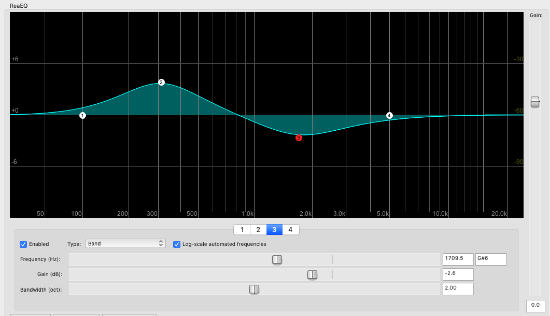
Some of those units of measurement are visible over here on the left [above]: there's a frequency control in Hertz, a Gain in decibels, and a Bandwidth control in octaves. Now, we don't need to worry much about what any of those mean [yet], but we can just note that there are these units of measurement, and that they can be increased or decreased over some range. When we're doing calibrated listening, we're listening to things and we're guessing or predicting (or maybe if we're really confident, we're knowing) what the corresponding measurements would be. And this is obviously a really useful kind of listening if we're going to be working with particular audio hardware and software in what we're doing, because if we have cultivated the skill of calibrated listening (to some or other extent), then maybe we'll be able to dial in the settings that we want, or the settings that a project needs somewhat quicker than if we had to sort of wander around to find the right setting. That said, I think that wandering around to find the right setting is a large part of the way that we learn this skill, and it's also quite fun.