MEDIAART 2G03: Forms of sound
What is sound? And what do we mean by sound? Probably one of the answers that is on the tip of our tongues because we've heard it elsewhere or because we've maybe been taught it in a science class at school, is that sound is vibrating air molecules. Certainly this is one of the forms that sound takes, but that is by no means the only form sound takes.
In that, "physical" form of sound, somewhere in the air there's an increase or decrease in pressure that might be represented by this dark dot at the center of this diagram (below). And then over time, that increase or decrease in pressure dissipates out over space in all directions. And so maybe at a moment later we have an increase in pressure in this circular shape here. And maybe in another moment later still, we have another. That increase or decrease in pressure has become an even wider circle still, like ripples in a pond. This is what we might call the acoustic form of sound. It's all about how pressure waves formed of vibrating air molecules move around a space.
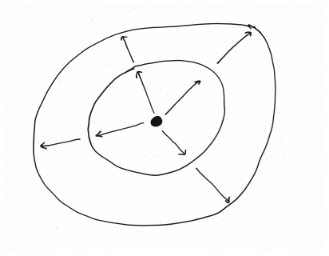
However, sound also exists in other forms that don't involve or don't directly involve vibrating air.
Consider for example, memories and imaginations. I'm pretty sure that each of you, if we asked you right now, would be able to imagine a sound. And that when you do that, there is no actual air molecules vibrating in that particular way. Something is happening in your brain, in your mind, possibly also in your body, as you engage in that exercise of imagination. You can probably also remember a sound without any actual air molecules vibrating in that way. And I think most interestingly of all, you can probably imagine and remember sounds that are beyond your experience. You can probably imagine and maybe even imagine that you remember things that you haven't heard before, although this can be difficult. I think one of the things we may discover among other things in this course, is that audio technologies can help us to imagine and remember sounds that are beyond our immediate experience.
What about storage signals, like the grooves on a vinyl LP? There's no actual vibrating air molecules, but it seems strange to say that the record doesn't contain sound. Closely related to a format like this would be an audio file in a computer–also a sound but not directly involving any vibrating air.
Closely related to that would be transmitted signals. When we run a cable from one kind of audio technology to another (a microphone cable, a guitar cable, or a speaker cable), we might say that there's a sound in that cable. For the most part, what's happening in these cables is that an electrical voltage is varying. Again, not vibrating air molecules, but still, sound. There are other forms of transmitted signals. Inside our audio devices there are little wires or little runs of metal that are carrying electrical voltages representing carrying sound. Sound is transmitted in the form of radio waves–AM radio, FM radio.
And it's transmitted increasingly in digital cables such as the USB cables that we might use to connect our computers to some kind of professional audio hardware, the HDMI cable that we might use to send a signal to a television. And as part of that digital signal, there is some information about sound. MADI is a type of cable that is used specifically for professional digital audio hardware that is carrying many channels of digital audio. Ethernet–a common format for connecting computers and other network devices together, but increasingly we're seeing audio signals being transmitted on such cables as well. We also see sounds being transmitted via Internet services such as streaming, and we can certainly see this as a kind of transmitted signal.
So we've seen that sound doesn't only take the form of vibrating air molecules.
And what the diagram below shows is I think a very typical audio situation. It's someone I think who is recording a singer over here. And the point of the diagram is really to underline that in situations where we work with audio, typically we're managing or paying attention to multiple forms of sound at the same time. The singer may have something in their imagination that is causing them to sing a certain way. That's resulting in pressure waves that are travelling some distance through the space to reach a microphone. The microphone is transducing those pressure waves into an electrical voltage, maybe goes through a preamplifier and becomes an even bigger electrical voltage. Then goes into an analog to digital converter that turns it into digital measurements and those measurements arrive at software and computer via USB cable. And maybe in that software, an audio file is being read in. And maybe also another one is being created as a result of a recording process. And at the same time as all of this is happening, all of those digital signals are being turned back into electrical voltages by digital to analog converter, and they were arriving at a pair of headphones, that let's say an audio engineer or some other creative person doing things with audio, is wearing. Those headphones are turning that back into pressure waves that are arriving at their ears. And maybe that person is forming perceptions of what they're hearing on that basis. And perhaps they're also going to remember what they heard, and the sound from the situation then will end up as memories in their head. So we've gone through in this very typical situation, someone recording a singer. We've gone through all of the different basic forms of sound that we talked about.
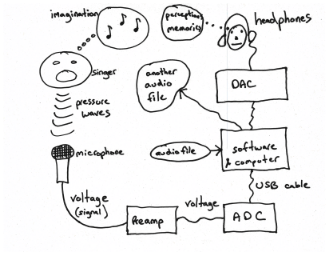
A note about terminology: audio vs sound
"Audio" tends to refer to sound as a stored or transmitted signal, so something in a cable, something in a record, or in an audio file. If we're dealing with those situations, we're definitely dealing with something where we can use the word "audio." For example, "audio signal," "audio file," the "Audio Engineering Society" is devoted to people who are often working with stored or transmitted signals, an "audio interface" is a piece of audio hardware that allows us to deal with sound as a signal.
So "audio" then refers to a subset, or part of the larger world of sound. And despite the title of this course, Digital Audio, we will usually be concerned with that larger world of sound. We can't really talk about audio without talking about sound...